
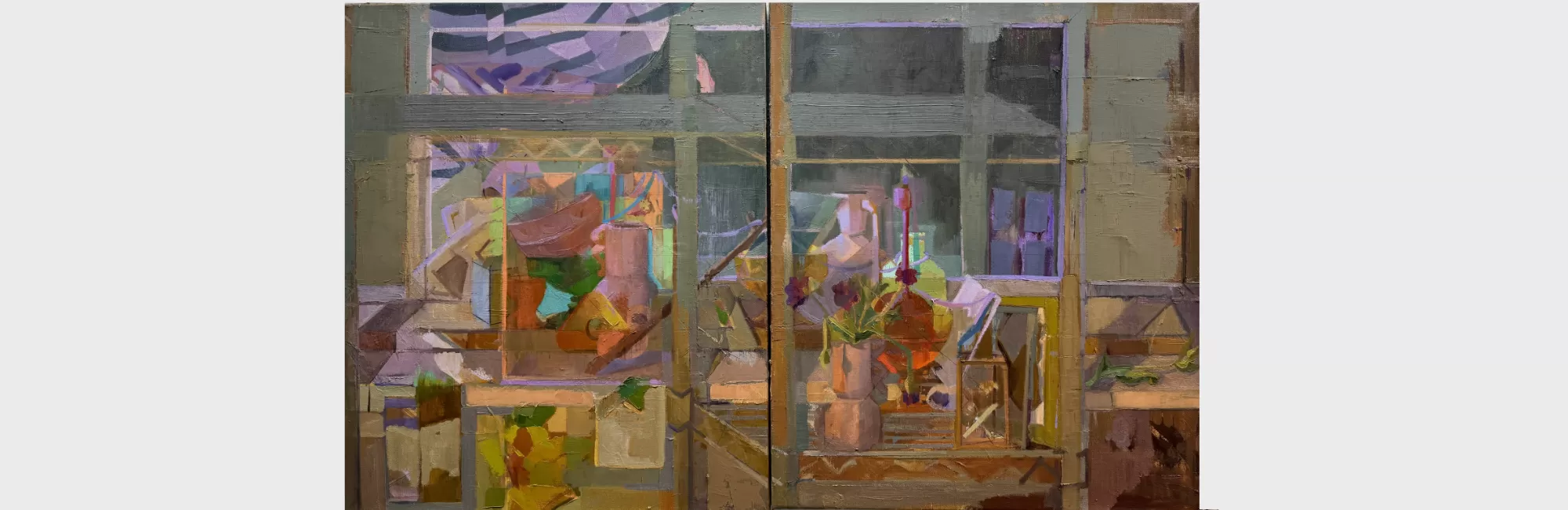
The Arranging of Things: Still Life Painting and the Language of Color


In this three-day workshop, students will explore the tension between construction and deconstruction through the arrangement—and rearrangement—of everyday objects. This workshop will guide students in moving beyond simply recording what they see through editing, cropping, rearranging, layering, and reinterpreting their source material. Drawing inspiration from both historical and contemporary painters, students will investigate how observation can become a point of departure for invention.
- Day 1, will begin with “gathering our data” by doing multiple quick oil sketches using a communal still life setup to observe from. We will use the language of color temperature, intensity, and hue to build form, describe qualities of light, and create dynamic compositional relationships.
- Day 2, we use our oil sketches from the previous day and begin finding connections by cutting, gluing, and using tracing paper to find how various forms may connect in order to create a new dynamic composition.
- Day 3, students finally will use their newly stitched-together composition and apply it to a larger ongoing oil painting surface.
Whether working representational or pushing toward abstraction, participants will develop a deeper understanding of color relationships, compositional design, and the expressive possibilities of still life painting.
All levels welcome, though some prior drawing or painting experience is helpful. Students may also choose to use water-based media such as acrylic if they are more comfortable in that medium, yet all live demos will be done in oils.
Required Supplies
- Suggested Oil Pigments:
- Mars Black
- Titanium White
- Cadmium Orange (or Permanent orange)
- Ultramarine Blue
- Phthalo Blue
- Dioxazine Purple
- Cadmium Yellow light (or hansa yellow light)
- Phthalo Green
- Cadmium Red Medium (or Napthol)
- Quinacridone Magenta
Please feel free to bring whatever you already have. You will at least need one red, orange, yellow, green, blue, and purple. They can vary from the above suggested pigments. Equivalent Acrylic Pigments also would work.
- Glass Palette for mixing oil pigment (preferred) or disposable Palette Paper Pad, Large (16”x20” ish)
- Assortment of bristle (rough) and smooth oil brushes - Instructor prefers Princeton’s Synthetic Mongoose brushes for smooths and Princeton’s Natural Bristle Brush for rough (round 4, 6)
Please bring whatever you already have/prefer. No need to spend a lot of money on brushes.
- Palette knife - Instructor prefer Blick’s Medium Trowel #30
- Small squeeze bottle
- Gamsol Odorless mineral spirits
- Linseed oil
- Pad of Arches Oil paper 12” or primed canvas paper
- One larger surface 18”x 24”
Students can use whatever they have ie stretched canvas, primed canvas paper; they could even paint over an old painting if they would prefer
- Artist Tape
- Foam core board to attach oil paper to
- Paper towels or old rags for oil paint cleanup
- Baby wipes
- Disposable gloves
- Vellum and/or tracing paper pads*
- Graphite Transfer Paper
- Scissors
- Ruler
- Cheap glue sticks
- Pencils
- Assortment of different color Sharpies
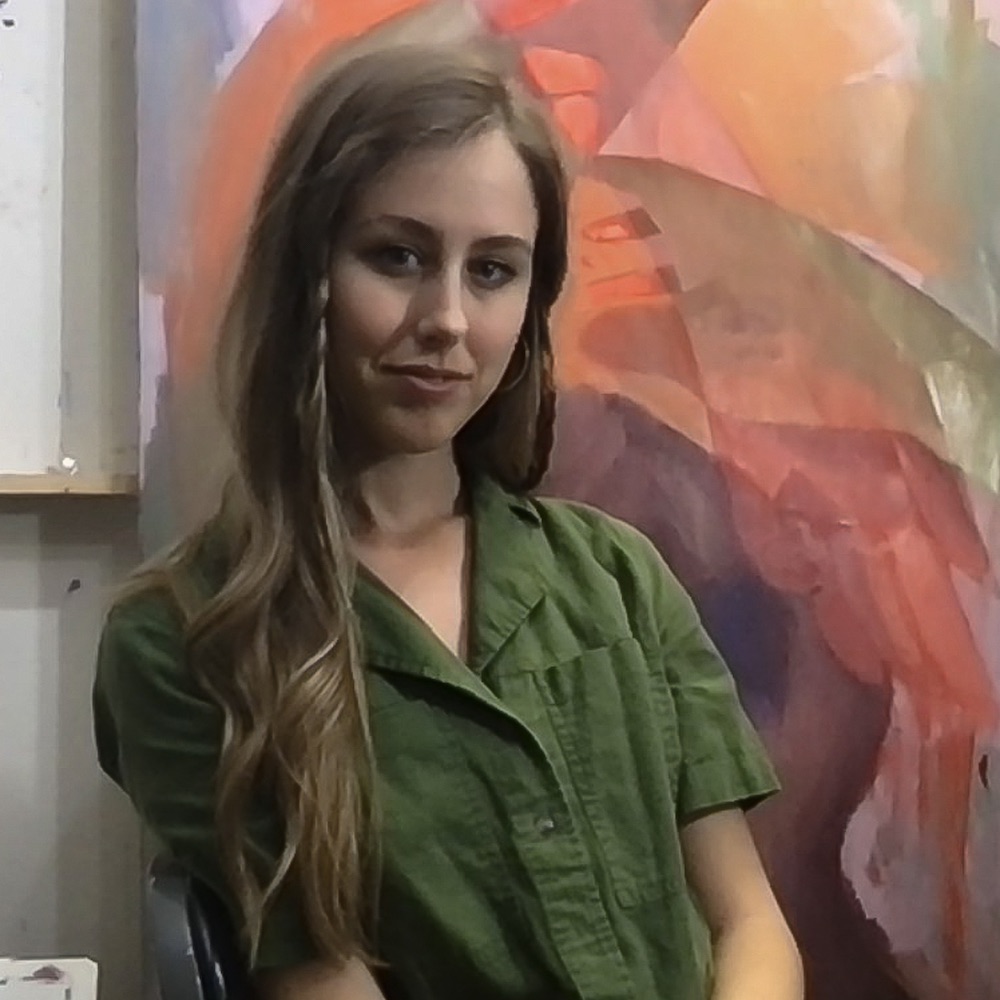
Ashley Johnson
Ashley is a painter, writer, nurse, and teacher based in Bremerton, Washington. She recently graduated with her MFA at the Pennsylvania Academy of Fine Arts...