
When a Student's Art Becomes a Seattle Landmark: Felicia "Felix" Bryan and the Amazon Whale Tail Selfless Station
By Gage Academy of Art | June 11, 2026
↵
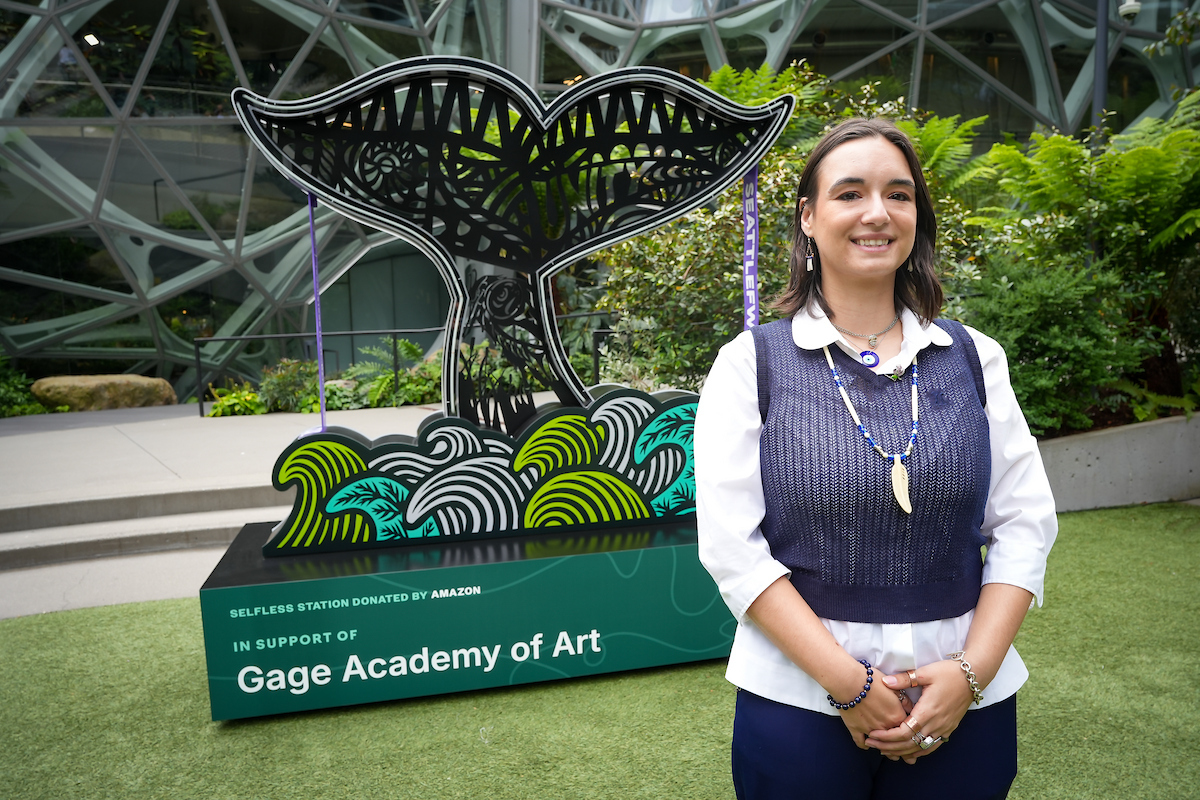
There are moments in an artist's journey when years of dedicated study, cultural identity, and community intersect in a single work. For Felicia "Felix" Bryan, enrolled Chinook artist and scholarship recipient in Gage Academy of Art's Atelier Program, that moment arrived on June 4, 2025, when Amazon unveiled the Whale Tail Selfless Station on the Day 1 Playfield as part of the Seattle Unity Loop.
This is not just a student success story. It is a testament to what happens when rigorous fine arts training meets an artist who has something meaningful to say.
Who Is Felicia "Felix" Bryan?
Felix Bryan came to Gage Academy of Art the way many of our strongest students do: already an artist, but hungry for the technical foundation to fully realize their vision.
Raised in a family of artists, Felix works fluidly across oil painting, beadwork, and block printing. These are not separate disciplines in her practice. They are interconnected languages for telling stories about emotion, cultural heritage, and lived experience. As an enrolled member of the Chinook Nation, Felix brings a perspective to her work that is deeply rooted in the Indigenous traditions of the Pacific Northwest Coast. That rootedness is not decorative. It is structural to everything she makes.
At Gage, Felix enrolled in our Atelier Program, a rigorous, studio-intensive curriculum built on the classical methods of the Old Masters, adapted for the working contemporary artist. The program emphasizes sustained observation, technical mastery, and the development of a personal artistic voice. Felix brought all three to the work that would eventually stand in the center of Seattle's biggest summer stage.
↵ ↵ ↵ ↵
"To me, the blue heron represents not only a culturally significant bird, but a local icon found all along the Salish coast. Merging two iconic silhouettes together that, to me, represent Seattle the best: nature and culture, water and heritage."
- Felicia "Felix" Bryan
The Work: sbəq̓ʷaʔ, The Great Blue Heron
Amazon's Selfless Stations are large-scale public art installations designed to serve a dual purpose: create a visually compelling gathering point and connect visitors to local nonprofit organizations doing meaningful work. Twenty-six pieces were commissioned for the Seattle Unity Loop, activated in conjunction with the 2026 FIFA World Cup, a moment when the entire world's attention turns to Seattle. Felix's design for the Whale Tail Selfless Station centers on the great blue heron, known in the Lushootseed language of the Coast Salish peoples as sbəq̓ʷaʔ.
The piece merges the heron's silhouette with the whale tail form, two shapes that carry enormous symbolic weight in Coast Salish spiritual traditions and in the everyday landscape of the Pacific Northwest. The heron moves between water and sky, between the seen and unseen world. The whale tail breaks the surface, bridging the deep and the light. Together, they create an image that honors the enduring connection between the natural and spiritual worlds while grounding itself in the specific geography and living culture of this region.
This is not imagery borrowed from tradition for aesthetic effect. Felix is an enrolled Chinook artist. This is her heritage, rendered with care and technical precision, placed in the heart of a city whose relationship with Indigenous culture is long, complicated, and still unfolding.
Why This Commission Matters for Arts Education
At Gage Academy of Art, we have always believed that training a fine artist means more than teaching them to render a form correctly. It means preparing them to carry ideas, complex, personal, and culturally significant ones, into work that can stand in the world with authority.
Felix's Whale Tail commission demonstrates exactly that preparation in action.
Public art at this scale demands clarity of concept, mastery of visual communication, and the confidence to speak to a broad and unfamiliar audience without diluting the work's meaning. Felix achieved all three. Her piece is immediately legible as a Seattle landmark. The shapes are iconic, the color and form are decisive. It is simultaneously layered with cultural and spiritual specificity that rewards closer attention.
That combination does not happen by accident. It comes from years of learning to see, learning to make, and learning to trust the ideas you carry.
The Atelier Program at Gage is built around exactly that kind of development. Students work in sustained studio practice under the guidance of accomplished working artists. They study composition, color theory, and technique through direct observation and intensive making. They are also encouraged to bring their full selves, their histories, their communities, their questions, into their work. For Felix, that full self includes a rich Indigenous artistic tradition, a multi-medium studio practice, and a clear sense of what she wants her art to do in the world.
The Installation and What Comes Next
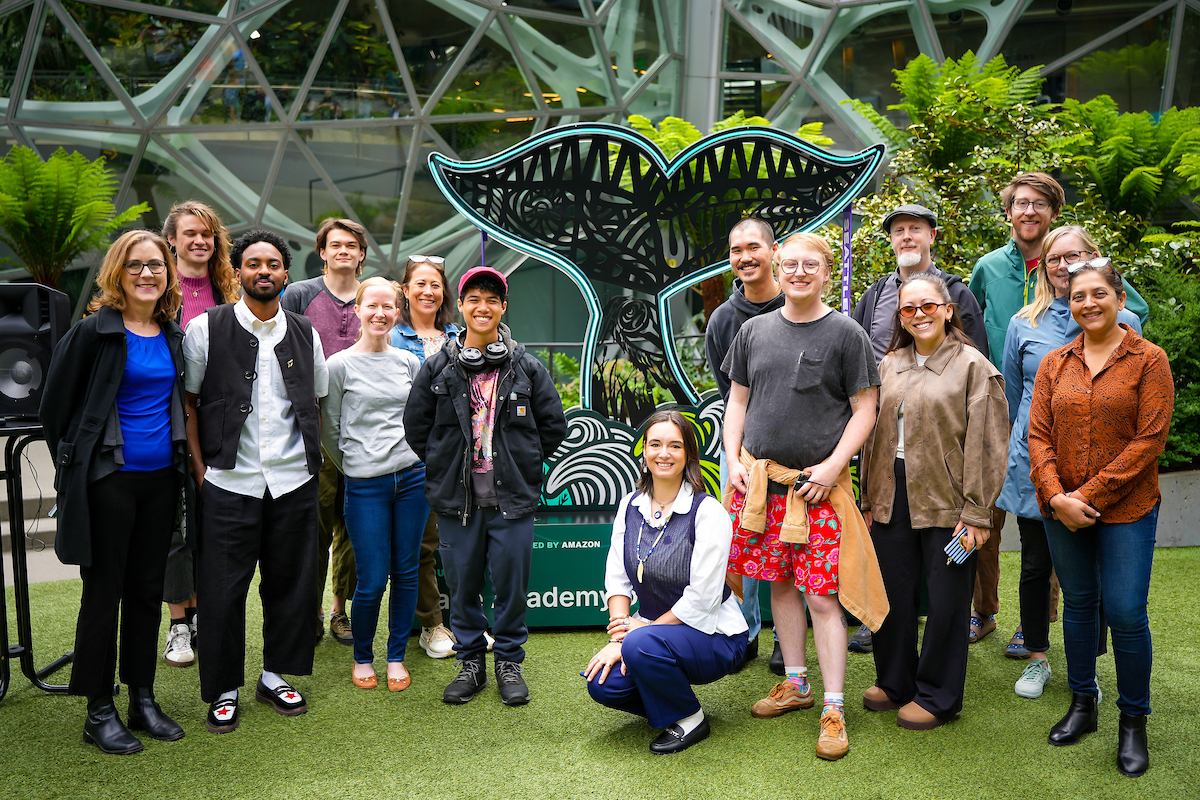
The Whale Tail Selfless Station is currently installed on Amazon's Day 1 Playfield in Seattle, where it will remain through the duration of the 2026 FIFA World Cup. Visitors can stop by, take a photo, and learn about the local nonprofit organizations the Selfless Station program supports.
After the World Cup concludes, the installation will move to its permanent location on Amazon's Seattle campus, where Felix's work will have a lasting presence in one of the most visited corporate campuses in the city.
We encourage everyone in the Seattle community to visit the installation. Engage with the work. Learn the name of the bird depicted, sbəq̓ʷaʔ, and the tradition it represents. Read about the nonprofits the station highlights. And recognize that the artist who made this piece is a Gage Academy student who is right now continuing to develop her practice in our studios.
Felicia "Felix" Bryan is an enrolled Chinook artist and scholarship recipient in the Gage Academy of Art Atelier Program. Her Whale Tail Selfless Station is on view at Amazon's Day 1 Playfield in Seattle through the 2026 FIFA World Cup.